





Protein calculator
Protein needs depend on your body weight, age, activity level and goals. Answer six quick questions to see your daily protein range and how egg white protein can help you reach it.
How we calculate
Your range is based on your body weight. For healthy adults, the European Food Safety Authority (EFSA) sets a population reference intake of 0.83 g of protein per kg of body weight per day, the same for women and men. This is still the official EU value, and a 2024 review of protein requirements confirms it.
For adults aged 65 and over, the Nordic Nutrition Recommendations 2023 recommend 1.2 g per kg, and the German, Austrian and Swiss nutrition societies (D-A-CH) 1.0 g per kg. From age 65, we use at least 1.0–1.2 g per kg.
For people who exercise regularly, the International Society of Sports Nutrition (ISSN) suggests 1.4–2.0 g per kg, with about 20–40 g of protein per meal. A 2018 meta-analysis of 49 studies found that extra gains in muscle mass level off at around 1.6 g per kg.
During pregnancy, EFSA adds 1 g, 9 g and 28 g of protein a day in the first, second and third trimester. During breastfeeding, it adds 19 g a day for the first six months and 13 g a day after that.
If you enter your height and your body mass index (BMI) is above 30, the calculation uses an adjusted body weight instead of your actual weight: the weight at a BMI of 25 plus 40% of the difference. This keeps the result realistic at higher body weights.
The amount per meal is your daily range divided over 3–4 meals. Daily results are rounded to the nearest 5 g.
This calculator gives general guidance for adults and is not medical advice. If you are under 18 or have a medical condition such as kidney disease, talk to a healthcare professional about your protein needs. During pregnancy and breastfeeding, follow the advice of your midwife or doctor. Food supplements should not replace a varied, balanced diet and a healthy lifestyle.
Products for you
-
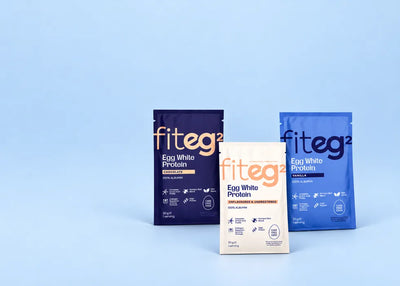
Egg White Protein Powder Unflavoured & Unsweetened
Regular price €34,95Regular price -
Egg White Protein Powder Chocolate
Regular price €34,95Regular price -
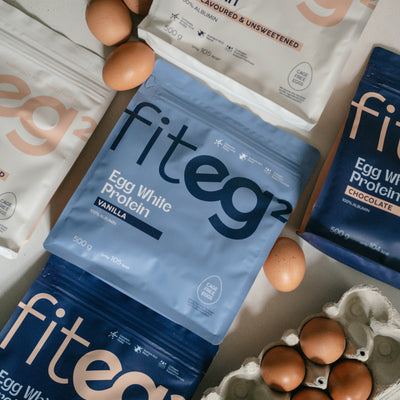
Egg White Protein Powder Vanilla
Regular price €34,95Regular price -
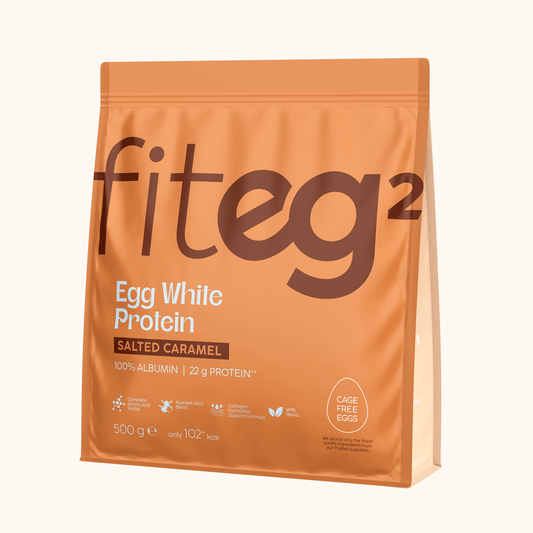
Egg White Protein Powder Salted Caramel
Regular price €34,95Regular price